
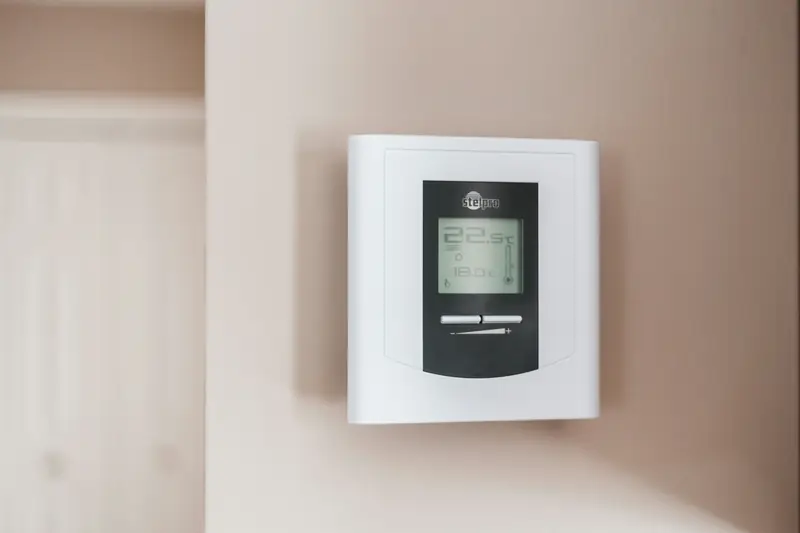
Signs you need a thermostat replacement
Suspect the thermostat when the display is blank or erratic, the temperature it shows doesn't match the room, the system won't start or won't stop, or it runs in short bursts with no other cause.
- Blank or flickering display, even after fresh batteries.
- Reading is off by several degrees compared to a thermometer placed beside it.
- The system ignores it: you change the setting and nothing happens, or the system keeps running after the set temperature is reached.
- Short cycling with equipment that checks out fine, often from a thermostat in direct sun or near a supply register.
- A smart thermostat that keeps losing power or Wi-Fi, usually because there's no common (C) wire.
- A heat pump that runs on "aux heat" all the time, which is often a thermostat setup problem.
Rule out the easy things first: batteries, the breaker, and the furnace door switch. If the thermostat checks out and the system still won't run, the problem is in the equipment. See AC repair or furnace repair.
Choosing a smart thermostat for your HVAC system
- Gas furnace with AC: almost any programmable or smart thermostat works, as long as it supports the number of heating and cooling stages.
- Heat pump: the thermostat must support heat pumps, including the reversing valve (O/B) and auxiliary heat with outdoor-temperature lockouts. Many standard setups get this wrong.
- 2-stage or variable-speed equipment: a thermostat that only sends a single "on" signal wastes the equipment's lower stage. Some variable-speed systems need the manufacturer's own communicating thermostat to use all their features.
- Zoned systems: each zone needs a thermostat compatible with the zone control panel.
- Wall furnaces and floor furnaces: many run on millivolt or line-voltage controls, which standard smart thermostats can't operate. These need a thermostat made for that type of heater.
- Mini-splits: these use their own remotes and apps, and a wall thermostat usually isn't needed.
Smart thermostat wiring and the C-wire
Smart thermostats need constant power, normally from a common (C) wire. Many older Santa Rosa homes have only 2 to 4 thermostat wires, with no C wire. The options are using a spare conductor in the existing cable, running a new cable, or installing a power adapter kit at the furnace.
Thermostats that "steal" power without a C wire can cause clicking, short cycling, or furnace control board problems on some equipment. Wiring is also where most do-it-yourself installs go wrong, especially on heat pumps.
Where to install a thermostat
A thermostat reads the air around it. On an outside wall, in afternoon sun, near a supply register, above a lamp, or next to the kitchen, it reads wrong and runs the system wrong.
Relocating it to an interior wall in the main living area, about 5 feet up, often fixes comfort complaints by itself. On 2-story homes, remote sensors in upstairs bedrooms let the thermostat average temperatures across floors.
How thermostat installation works
- Identify the equipment, including the number of stages, heat pump or furnace, any accessories, and the existing wiring at both the thermostat and the equipment.
- Power off at the furnace or air handler.
- Wire it, adding a C wire or adapter if needed and labeling conductors at both ends.
- Configure it: equipment type, stages, heat pump settings, aux heat lockout, fan settings, and cycle rates.
- Test every mode, including heating, cooling, fan, each stage, and backup heat.
- Set the schedule and app with you, built around your PG&E rate.
Setting your thermostat for PG&E time-of-use rates
Most PG&E residential customers in Santa Rosa have been moved to time-of-use pricing. On PG&E's standard E-TOU-C plan, electricity costs more from 4 p.m. to 9 p.m. every day, weekends included.
Homes that get generation from Sonoma Clean Power still follow PG&E's time periods. On a Santa Rosa summer day, 4 to 9 p.m. is also when the house is hottest and the AC works hardest, so peak pricing lines up with peak cooling.
A smart thermostat can shift some of that cooling earlier:
- Summer pre-cooling: cool the house a couple of degrees below your normal setting in early afternoon, before 4 p.m. Then let it drift up a few degrees through the peak window. The house holds the coolness for a while, especially if blinds on west-facing windows are closed.
- Heat pumps in winter: avoid big setbacks that force a large recovery during the evening peak or bring on backup strip heat. A steady setting usually costs less.
- Evening cooling: on most summer evenings, marine air cools Santa Rosa after sunset. Raise the setpoint at 9 p.m. and open windows if the air is clean, instead of running the AC.
Check your own PG&E bill for your rate plan, since some households are on different plans with different peak hours.
What affects thermostat installation cost
- The thermostat itself, from basic programmable to smart and communicating models.
- Wiring: using existing wires versus adding a C wire, new cable, or an adapter.
- System complexity: heat pumps, dual fuel, multi-stage, and zoned systems take longer to configure correctly.
- Relocation: moving the thermostat to a better wall means new wiring and patching.
- Remote sensors for upstairs rooms or problem areas.
When a thermostat problem is urgent
A thermostat failure is urgent only when it leaves the house with no heat or cooling in dangerous weather for someone vulnerable. Try fresh batteries and check the breaker first, because many "dead thermostat" calls end there. If it's still dead and the house is getting dangerously hot or cold, call our 24/7 emergency line.
Thermostat setup ties directly into the rest of the heating and cooling repair in Santa Rosa HVAC Pros does. A correctly configured thermostat is part of every heat pump and furnace installation.
Smart thermostat FAQs
Do I need a C-wire for a smart thermostat?
Most smart thermostats need one for steady power. If your wall has no C wire, a spare conductor in the cable, a new cable, or an adapter at the furnace can provide it. Running without one can cause dropouts or erratic cycling on some systems.
Will a smart thermostat work with my heat pump?
Most current smart thermostats support heat pumps, but they have to be wired and configured for the reversing valve and auxiliary heat. A wrong setting can leave the system running on expensive backup heat without you noticing.
Can I put a smart thermostat on my wall furnace?
Usually not a standard one. Many wall furnaces use millivolt or line-voltage controls. Thermostats made for those heaters exist, and some homes add a mini-split, whose own controls are smart, instead.
Does a smart thermostat actually save money?
It can, mainly by avoiding heating and cooling an empty house, shifting cooling ahead of PG&E's 4 to 9 p.m. peak, and keeping a heat pump off backup heat. The savings depend on your habits and how the schedule is set up.
Get a smart thermostat installed in Santa Rosa
Call HVAC Pros at (707) 283-3186 to install and set up a smart or programmable thermostat for your furnace, AC, or heat pump, with a schedule built around your PG&E rate.